Hello, I am Rosalino, a software engineer.
In the related article “What Is an NFT Diploma? A New Approach to ‘Proof of Learning’ for Educational Institutions” the background of why NFT diplomas are gaining attention was explained from the perspective of “proof of learning” in the education field.
However, opportunities to explain how such a system actually works from a technical perspective are still limited.
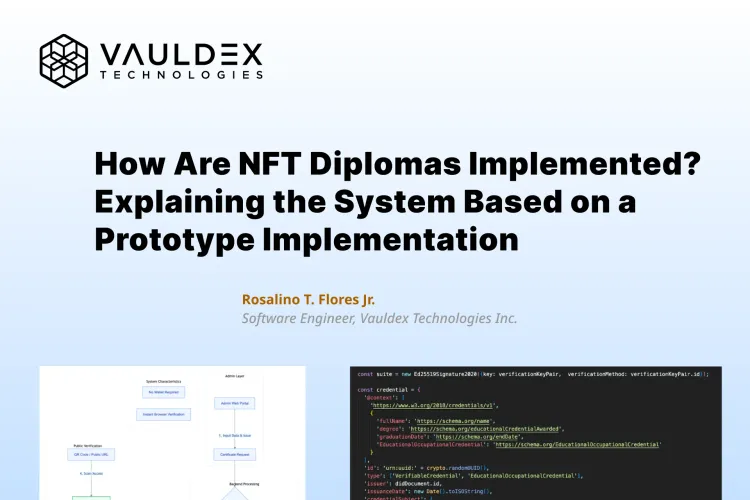
In this article, I implemented a minimal prototype and organized the flow from issuance to verification in order to examine how an NFT diploma system can be realized. This article explains the mechanism from a technical perspective following the process from issuance to verification.
Table of Contents
How the Mechanism of NFT Diplomas Works
System Architecture of NFT Diplomas
Challenges During Implementation
What Was Confirmed Through Verification
Issues Identified Through Verification
Closing Thoughts
1. How the Mechanism of NFT Diplomas Works
The concept of NFT diplomas has been introduced more frequently in recent years. However, it is still not often explained from a technical perspective how such a system would actually operate in practice.
For example, questions such as the following arise:
Who issues the diploma
How a third party verifies its contents
Whether verification always requires contacting the issuing institution
If these points remain unclear, it would be difficult to use such diplomas as actual credentials.
For this reason, I decided to build a prototype and verify whether it is possible to issue diplomas digitally and allow third parties to independently confirm their contents. In this prototype, the goal was to confirm whether the entire flow could work end to end: issuance, the student holding the diploma, and verification by a third party.
2. System Architecture of NFT Diplomas
The most important objective of this prototype was to create a structure in which a diploma issued digitally could be verified by a third party. Technologies such as blockchain-based proof and Verifiable Credentials (VC) are often used to implement digital credentials of this kind. The implementation of blockchain integration and NFT issuance logic is explained in more detail in the following article:
Implementing Conditional NFT Minting Logic with LINE Mini Dapp and Kaia
A PDF diploma may appear official, but its contents can be modified relatively easily. Another option is to manage diplomas through a centralized database, but in that case verification would require contacting the issuing institution each time. Writing the information directly to a blockchain is also possible.
However, this approach raises practical concerns such as how to handle personal information and how updates or revocation should be managed.
Based on these considerations, this prototype uses digitally structured certificates signed by the issuing institution, allowing third parties to verify the signature.
The prototype was implemented with the following components:
An administrative interface for issuing diplomas
A backend process that signs certificates
Off-chain data storage
A public verification page accessible to anyone
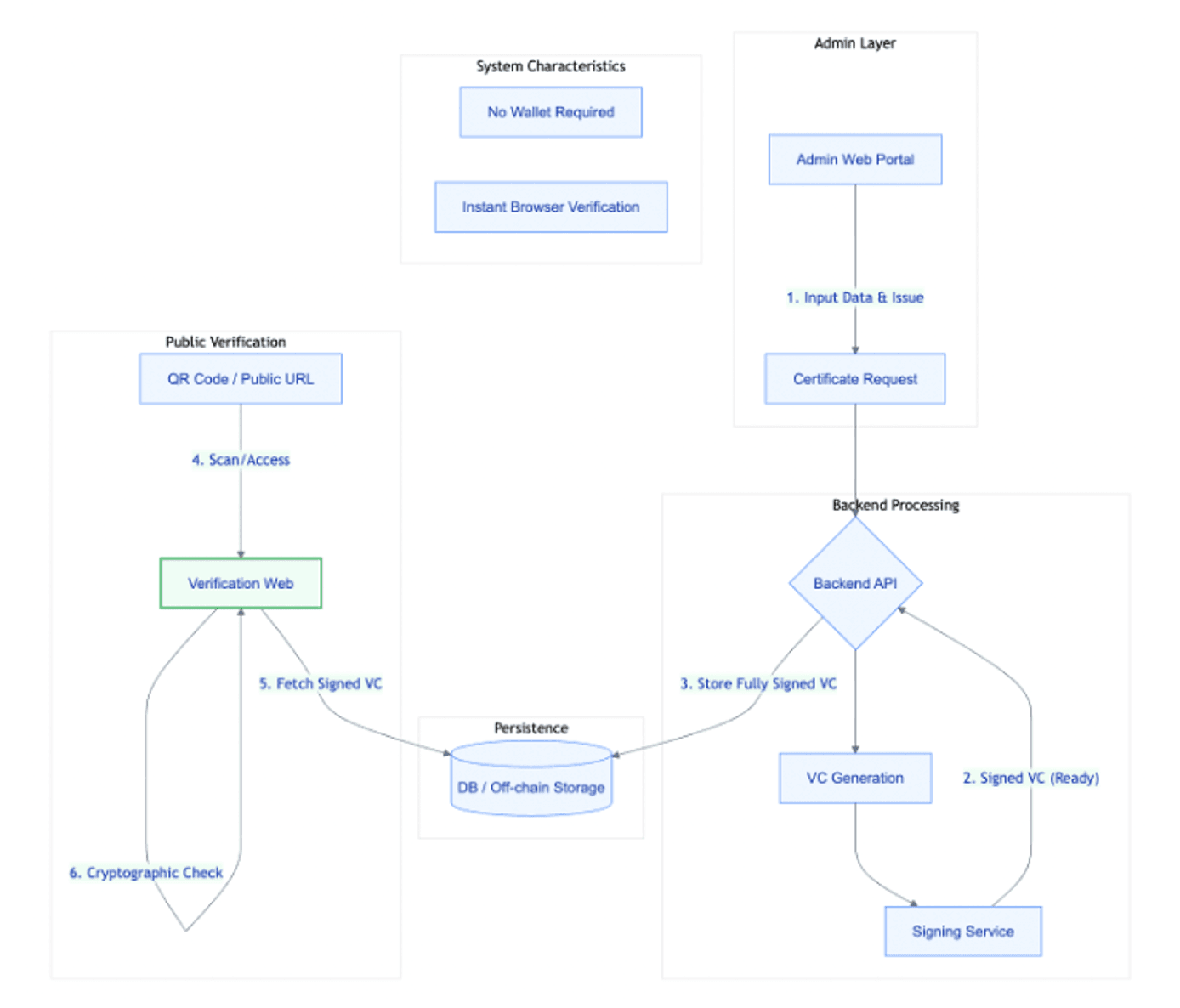
Although blockchain integration was considered, the objective of this prototype was to confirm whether the system could function as a diploma issuance and verification mechanism. For that reason, the implementation was intentionally limited to a minimal structure.
3. Challenges During Implementation
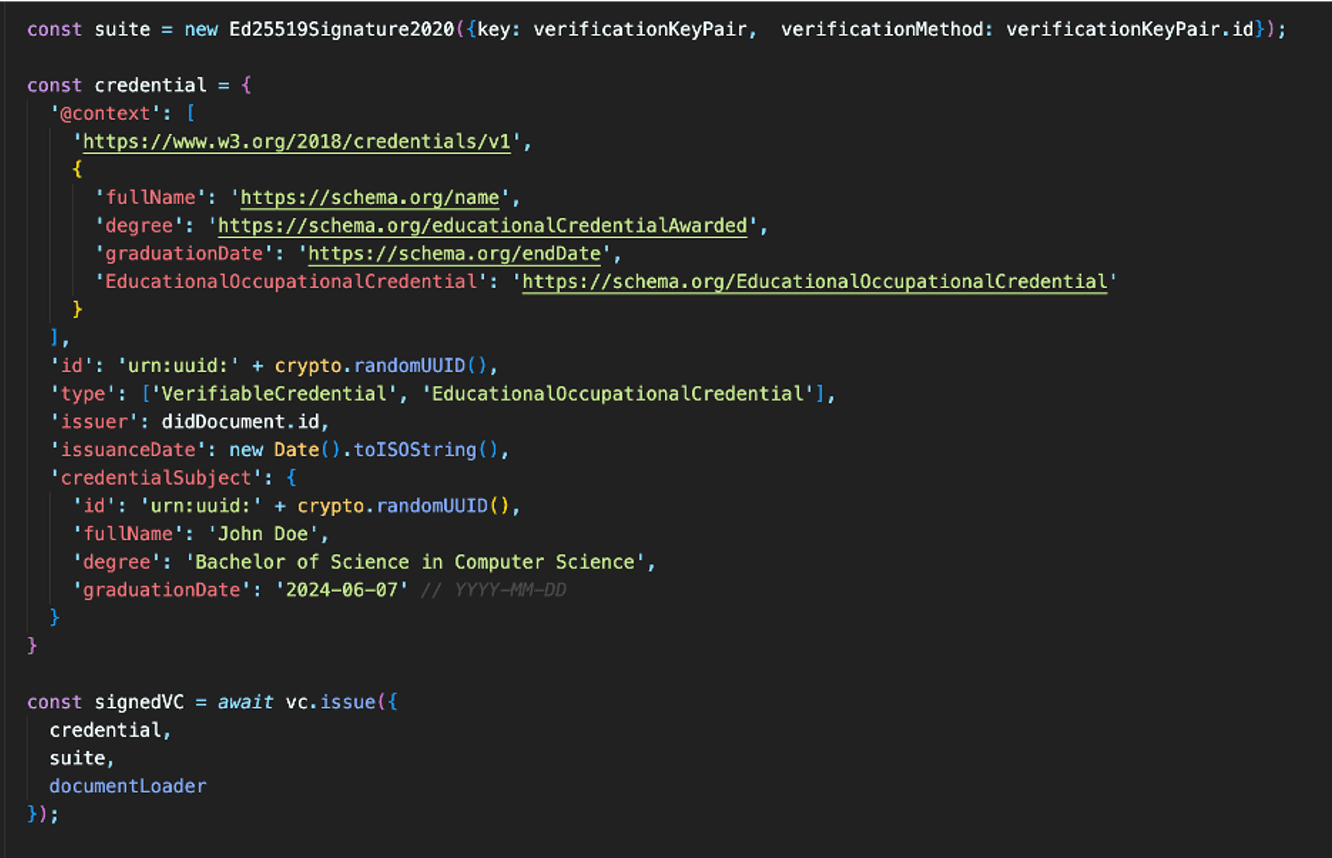
The most time consuming part of the implementation was determining how to represent the information written on a diploma in a form that systems can correctly interpret.
Examples include the following items:
Student ID
Degree
Major
Graduation date
These fields are easy for humans to understand, but the system itself cannot determine the exact meaning of the data without clear definitions. Therefore it was necessary to review each item carefully.
First, we checked whether existing standard terms could be reused.
If they could not be reused, we needed to define the meaning explicitly.
Each field had to be examined individually. Initially it seemed possible to freely add new fields. In practice, however, the system only worked correctly when definitions and conventions were strictly aligned.
Defining the meaning and structure of the data in advance turned out to be a key requirement for making the system function correctly.
4. What Was Confirmed Through Verification
For the generated certificates, it was possible to issue diplomas from the administrative interface and verify their contents through a verification URL.
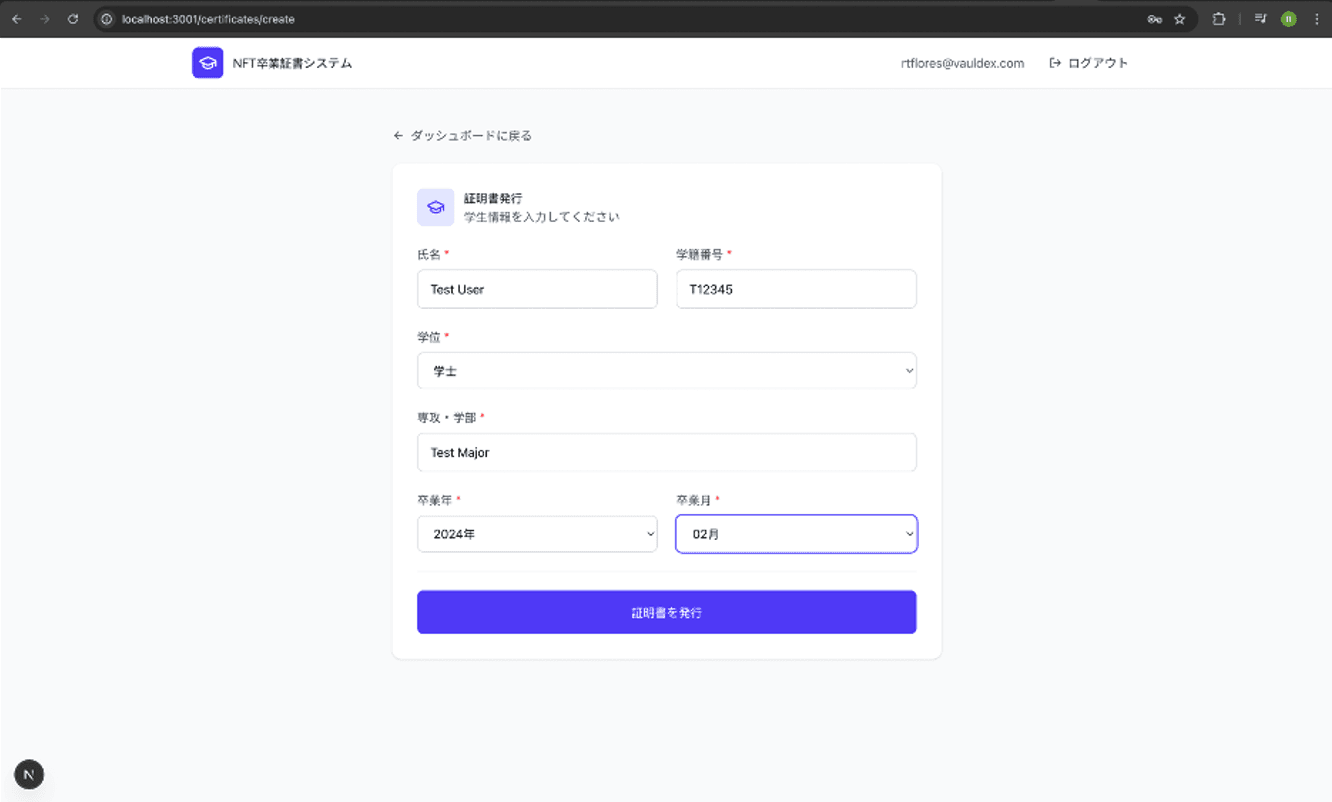
When considering real world use as a diploma system, the following points are particularly important:
Verification does not require contacting the issuing institution
No special wallet is required to perform verification
At the same time, we also confirmed that verification could fail even when only a small change was made to the fields or structure.
This showed that the data structure is stricter than expected. It will likely be necessary to abstract this complexity in the user interface so that users can interact with the system without needing to be aware of it.
5. Issues Identified Through Verification
Through this prototype, several points became clear:
NFT diplomas are not just a concept and can be implemented in practice
What matters is not whether a blockchain is used, but whether third parties can independently verify the contents
Data structure, definitions, and management rules are more important than visual appearance
At the same time, there are still many points that need to be organized when considering real world adoption, such as deciding which guarantees should be handled by the system itself and which should be managed through operational processes.
6. Closing Thoughts
Although NFT diplomas are often discussed as a concept, the actual system architecture behind them is still not widely understood.
Through this prototype verification, it became clear that a system in which diplomas are issued digitally and verified by third parties can be implemented with a relatively simple structure.
The key point is not simply the use of blockchain technology. What matters is how to design a structure that allows third parties to verify the authenticity of the credential.
When educational institutions consider adopting NFT diplomas, it is important to organize not only the technical aspects but also operational design and the scope of adoption.
For points that institutions should consider when evaluating adoption, please refer to the following article for a more detailed explanation.
NFT Diplomas : An Implementation Guide for Educational Institutions